|
---------------------------- 2026 Platform Presentation Winner --------------------------
Large-scale Validation Confirms Lack of
Prognostic Impact of Aberrant p53 Status in
POLEmut and MMRd Endometrial Carcinoma
Lisa Vermij, Jutta Huvila, Amy Jamieson, Jessica N. McAlpine, Samuel CY Lueng, Jan Jobsen, Vincent Smit, Stephanie M. de Boer, Remi A. Nout, Melanie E. Powell, Lois Shepherd, Nienke Kuijsters, Marie A.D. Haverkort, Marianne A.A. de Jong, Rubina Razack, Jennifer L. Butt, Cor D. de Kroon, Carien L. Creutzberg, Tjalling Bosse, C. Blake Gilks, Nanda Horeweg
Background:A small but clinically relevant subset of endometrial carcinomas
(EC) have more than one molecular classifying feature; e.g. a
pathogenic POLE mutation as well as mismatch repair
deficiency, and/or abnormal p53-expression. Prior studies
suggest these patients with POLE-mutated (POLEmut) or
mismatch repair deficient (MMRd) tumors that also have
aberrant p53 expression, so-called “double classifiers”, have
clinical outcomes and genomic profiles more aligned with
single-classifier POLEmut or MMRd tumors respectively. Using
the largest collection of molecularly classified EC-cohorts to
date, we evaluated whether aberrant p53 status affects
outcome in such cases.
Design: We analyzed tumor material from 12 international molecularly
classified EC cohorts (retrospective, prospective, and
randomized clinical trials; n=5958). Cases harboring a
pathogenic TP53 mutation and/or aberrant p53
immunohistochemistry together with a pathogenic POLE mutation and/or MMR deficiency were included. Recurrencefree
survival (RFS) was compared among patients with
POLEmut-p53abn, MMRd-p53abn and POLEmut-MMRd-p53abn
EC versus their respective single-classifier counterparts using
Kaplan-Meier and log-rank tests.
Results: We identified 164 (2.8%) double classifier EC, including 51
(31.1 %) POLEmut-p53abn EC, and 113 (68.9 %) MMRdp53abn
EC. The stage distribution was as follows; 120 stage I
(73.2%), 17 stage II (10.4%), 22 stage III (13.4%), and 5
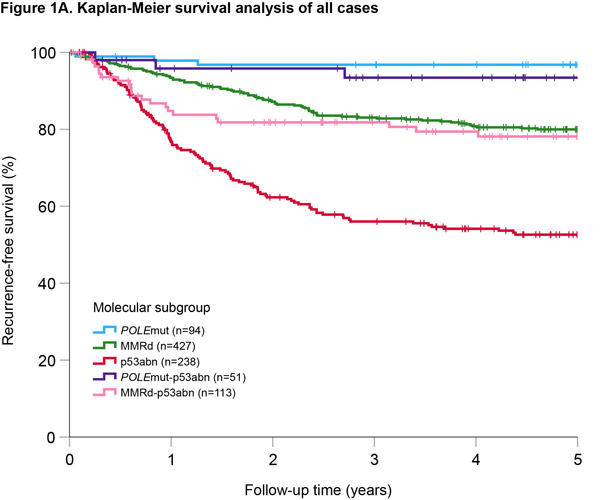
stage IV (3.0%). Five-year RFS (Figure 1A) did not differ
between POLEmut-p53abn and POLEmut tumors (93.4% vs
96.8%; p = 0.48) or between MMRd-p53abn and MMRd tumors
(78.1% vs 80.0%; p = 0.63). In contrast, single-classifier
p53abn EC showed markedly worse 5-year RFS (52.6%).
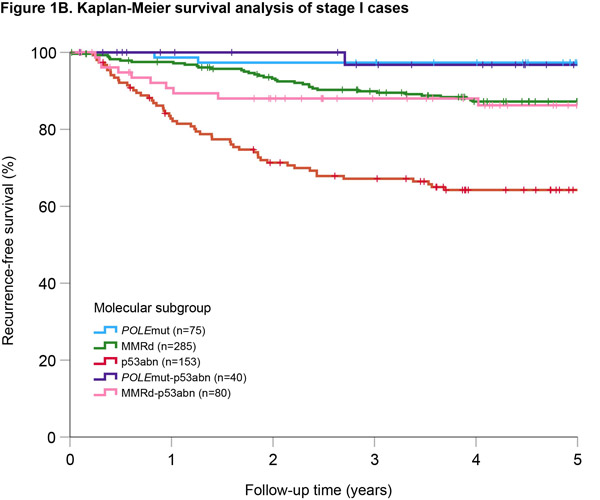
Subanalyses including only stage I cases (Figure 1B), for which
molecular classification has a great impact on clinical
management, also revealed no significant differences in fiveyear
RFS between POLEmut-p53abn and POLEmut tumors
(96.8% vs 97.3%; p = 0.78) or between MMRd-p53abn and
MMRd tumors (87.2% vs 86.3%; p = 0.94).
Conclusions: Aberrant p53 status does not impact prognosis in EC with
pathogenic POLE mutations or MMR deficiency. These findings
further support classifying POLEmut-p53abn as POLEmut EC,
and MMRd-p53abn as MMRd EC.
|